Nvidia GeForce RTX 5060
Released 2025/05
PNY GeForce RTX 5060 8GB Dual Fan OC
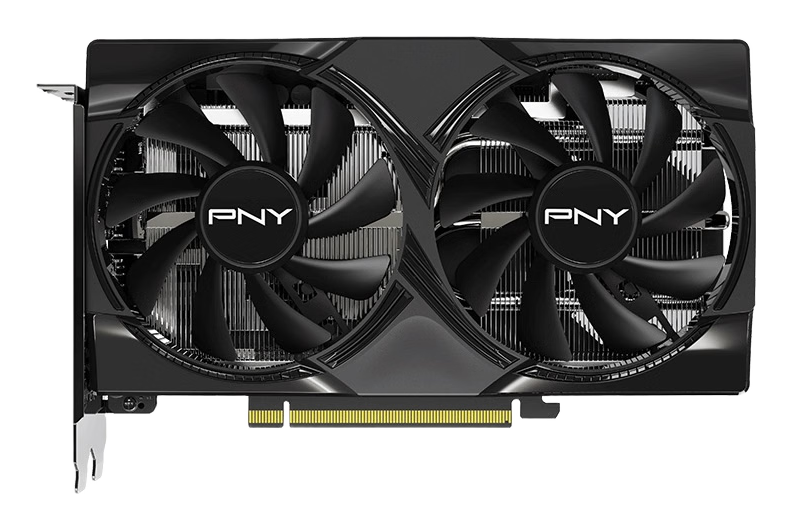
Specifications
8 GB
GDDR7 VRAM
448 GB/s
Bandwidth
2280 MHz
Boost clock
145 W
Board power
About this GPU
The RTX 5060 is Nvidia's entry point into the current Blackwell generation, sitting at the bottom of the RTX 50 series stack. It's built for 1080p gaming and works well there, but the 8GB VRAM cap creates real friction at 1440p in 2026's more demanding titles. If your monitor tops out at 1080p and you're upgrading from something like an RTX 2060 or 3060, this card makes sense. If you're already on a 1440p display or planning to move to one, the VRAM ceiling will chase you sooner than you'd like.
In rasterized games at 1080p, the 5060 sits roughly level with the older RTX 3070 and AMD's Radeon RX 7700 XT - think 66 FPS in Starfield, around 46 FPS in Black Myth: Wukong at 1440p native, and only a handful of frames between it and the GeForce RTX 4060 Ti 16GB in most scenarios. The generational jump from the GeForce RTX 4060 is around 25% in rasterization and 23-27% in ray-traced titles. That's a real but modest step, not a leap. Where the card earns more of its keep is with DLSS 4 and Multi-Frame Generation - exclusive to Blackwell hardware - which can push frame rates well beyond what the raw raster numbers suggest, though those boosted counts depend heavily on base frame rate stability and introduce the usual frame-gen caveats around latency perception. The GeForce RTX 5060 Ti 16GB consistently leads by 15-25% across both resolutions, so the gap between the two is not trivial.
The 8GB VRAM situation is worth taking seriously. At 1080p it's largely fine at high settings. At 1440p in texture-heavy titles - especially with ray tracing active - you'll start seeing stutters, texture pop-in, or be forced to dial back quality settings to stay under the buffer. This isn't theoretical: testing across multiple 2026 titles shows measurable frame-time inconsistency at 1440p ultra settings compared to 16GB cards in the same tier. Dropping to high settings usually recovers stability, but that's a tradeoff the competing Radeon RX 9060 XT 16GB doesn't force on you.
On the power side, the 5060 draws around 145W under load, which is genuinely low for current-gen performance. It fits into most existing systems without a PSU upgrade, runs cool under most AIB cooler designs (mid-60s Celsius is typical at stock), and is physically compact enough to work in smaller cases.
Pros and Cons
Pros:
- Very low 145W TDP means it runs cool, quiet, and fits into builds with modest power supplies
- DLSS 4 with Multi-Frame Generation support, exclusive to RTX 50 series hardware
- Noticeably better ray tracing than the RTX 4060, roughly on par with the old RTX 3080 in RT workloads at 1080p
- Solid 1080p performer in the current Blackwell lineup with strong driver and feature support
Cons:
- 8GB VRAM is the only option - no 16GB variant exists - and it creates real limitations at 1440p in texture-heavy and RT workloads
- Raw rasterization improvement over the RTX 4060 is meaningful but not dramatic; users upgrading from a 4060 Ti 16GB will see a regression in VRAM headroom
- DLSS Multi-Frame Generation inflates headline FPS numbers in ways that don't always translate to equivalent feel, particularly at lower base frame rates
- The competing Radeon RX 9060 XT 16GB offers comparable native performance with double the VRAM
Alternatives
- comparable gpu: Radeon RX 9060 XT 16GB - Essentially matched in raw rasterization performance, but the 16GB GDDR6 buffer removes the 1440p texture ceiling entirely
- budget pick: Arc B580 - Noticeably slower overall but carries 12GB of VRAM; a reasonable fallback for pure 1080p builds where DLSS isn't a priority
- upgrade pick: GeForce RTX 5060 Ti 16GB - The clear step up - 15-25% faster across common resolutions and available with 16GB for better 1440p headroom
Price history
Price history excludes Amazon sources
Affiliate link disclosure: some product links on this page may be affiliate links. If you click on these links and make a purchase, we may earn a commission. This doesn't affect the price you pay or influence which listings are displayed.
Listings
Listings sorted by Price, ascending.