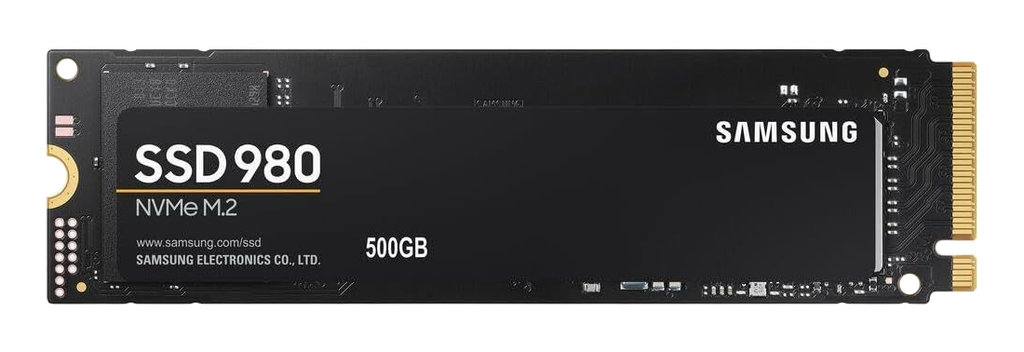
Samsung 980 500GB
500GB · M.2 2280 · PCIe 3.0 x4
Specifications
No
DRAM cache
3100 MB/s
Sequential read
2600 MB/s
Sequential write
300 TBW
Endurance
Family guide
Samsung EVO and 980 NVMe SSDs| 970 EVO | 970 EVO Plus | 980 This model | 990 EVO | 990 EVO Plus | |
|---|---|---|---|---|---|
| Released | 2018 | 2019 | 2021 | 2024 | 2024 |
| Interface | PCIe 3.0 x4 | PCIe 3.0 x4 | PCIe 3.0 x4 | Not available | Not available |
| Read | 3400 MB/s | 3500 MB/s | 3100 MB/s | Not available | Not available |
| Write | 2300 MB/s | 3200 MB/s | 2600 MB/s | Not available | Not available |
| Endurance | 300 TBW | 300 TBW | 300 TBW | Not available | Not available |
| Summary | Has a DRAM cache, like the 970 EVO Plus; the 980 and 990 models use system memory instead. | 1TB and 2TB batches made from mid-2021 use different parts and write slower once the cache fills. | Samsung's first DRAM-less NVMe drive; it borrows a little system memory (HMB) instead of carrying its own. | Rated for the same speeds over PCIe 4.0 x4 or 5.0 x2, so a PCIe 5.0 slot doesn't make it faster. | Same controller and dual interface as the 990 EVO, with newer flash that uses power more efficiently. |
Capacity grid
| 250GB | 500GB | 1TB | 2TB | 4TB | |
|---|---|---|---|---|---|
| 970 EVO | $199.99 | $229 | $334.99 | Not available | Not available |
| 970 EVO Plus | $85.15 | $140.98 | $179.56 | $399 | Not available |
| 980 | $78.84 | $130.54 This model | $149.99 | No listings | Not available |
| 990 EVO | Not available | Not available | $255 | $381 | Not available |
| 990 EVO Plus | Not available | Not available | $229.95 | $329.98 | $617.50 |
Price history
$300$225$150$75$0
21 Apr05 Jun21 Jul05 Sept21 Oct
Price history excludes Amazon sources
Affiliate link disclosure: some product links on this page may be affiliate links. If you click on these links and make a purchase, we may earn a commission. This doesn't affect the price you pay or influence which listings are displayed.
Listings
Listings sorted by Price, ascending.
SAMSUNG SSD 980 500GB M.2 NVMe Solid State Drive Internal HDD For Laptop Desktop FOCMEMSUMMER26 Ebay USA $130.54 (NEW) SAMSUNG 500GB 980 SSD NVMe M.2 2280 SOLID STATE DRIVE MZ-V8V500B/AM Ebay USA $199.00 Samsung 980 M.2 500GB Samsung 980 NVME SSD MZ-V8V500B/AM Ebay USA $218.99 980 M.2 500 GB PCI Express Amazon USA $329.95 SAMSUNG SSD 980 NVMe M.2 2280 500GB PCIe 3.0 x4 1.4 V-NAND MLC MZ-V8V500BW Ebay USA $339.75 MZ-V8V500 Samsung 500GB 980 PCIe 3.0 x4 M.2 Internal SSD F/S Out of stock Ebay USA — NEW SAMSUNG 980 500GB NVMe SSD MZ-V8V500B/AM Out of stock Ebay USA — Samsung 980 SSD 500GB PCle 3.0x4, NVMe M.2 2280, Internal Solid State Drive, Storage for PC, Laptops, Gaming and More, HMB Technology, Intelligent Turbowrite, Speeds up-to 3,500MB/s, MZ-V8V500B/AM Out of stock Amazon USA —