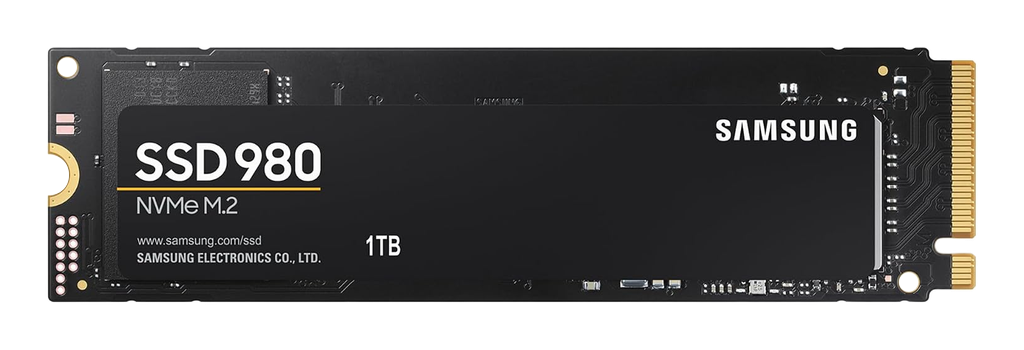
Samsung 980 1TB
1TB · M.2 2280 · PCIe 3.0 x4
Specifications
No
DRAM cache
3500 MB/s
Sequential read
3000 MB/s
Sequential write
600 TBW
Endurance
Family guide
Samsung EVO and 980 NVMe SSDs| 970 EVO | 970 EVO Plus | 980 This model | 990 EVO | 990 EVO Plus | |
|---|---|---|---|---|---|
| Released | 2018 | 2019 | 2021 | 2024 | 2024 |
| Interface | PCIe 3.0 x4 | PCIe 3.0 x4 | PCIe 3.0 x4 | PCIe 4.0 x4 / PCIe 5.0 x2 | PCIe 4.0 x4 / PCIe 5.0 x2 |
| Read | 3400 MB/s | 3500 MB/s | 3500 MB/s | 5000 MB/s | 7150 MB/s |
| Write | 2500 MB/s | 3300 MB/s | 3000 MB/s | 4200 MB/s | 6300 MB/s |
| Endurance | 600 TBW | 600 TBW | 600 TBW | 600 TBW | 600 TBW |
| Summary | Has a DRAM cache, like the 970 EVO Plus; the 980 and 990 models use system memory instead. | 1TB and 2TB batches made from mid-2021 use different parts and write slower once the cache fills. | Samsung's first DRAM-less NVMe drive; it borrows a little system memory (HMB) instead of carrying its own. | Rated for the same speeds over PCIe 4.0 x4 or 5.0 x2, so a PCIe 5.0 slot doesn't make it faster. | Same controller and dual interface as the 990 EVO, with newer flash that uses power more efficiently. |
Capacity grid
| 250GB | 500GB | 1TB | 2TB | 4TB | |
|---|---|---|---|---|---|
| 970 EVO | $199.99 | $229 | $334.99 | Not available | Not available |
| 970 EVO Plus | $85.15 | $140.98 | $179.56 | $399 | Not available |
| 980 | $78.84 | $130.54 | $149.99 This model | No listings | Not available |
| 990 EVO | Not available | Not available | $255 | $381 | Not available |
| 990 EVO Plus | Not available | Not available | $229.95 | $329.98 | $617.50 |
How it compares
Explore current prices and specifications in the category table. View all SSDs →
Select a tick for details and a product link.
Read chart product details
Price history
$400$300$200$100$0
21 Apr05 Jun21 Jul05 Sept21 Oct
Price history excludes Amazon sources
Affiliate link disclosure: some product links on this page may be affiliate links. If you click on these links and make a purchase, we may earn a commission. This doesn't affect the price you pay or influence which listings are displayed.
Listings
Listings sorted by Price, ascending.
1TB NVMe Drive Samsung SSD 980 V-NAND SSD MZ-V8V1TO MZVLQ1TOHBLB Ebay USA $149.99 Samsung 980 M.2 1tb Samsung 980 NVME SSD MZ-V8V1T0B/AM Ebay USA $297.49 (NEW) SAMSUNG 1TB 980 SSD NVMe M.2 2280 SOLID STATE DRIVE MZ-V8V1T0B/AM Ebay USA $299.00 Samsung 980 1TB PCIe 3.0 (up to 3,500 MB/s) NVMe M.2 Internal Solid State Drive (SSD) (MZ-V8V1T0BW) Amazon USA $349.00 SAMSUNG SSD 980 NVMe M.2 2280 1TB 1.0 TB PCIe 3.0 x4 1.4 V-NAND MLC MZ-V8V1T0BW Ebay USA $349.95 Samsung SSD 980 1TB PCle 3.0x4, NVMe M.2 2280, Up to 3,500MB/s Out of stock Amazon USA —