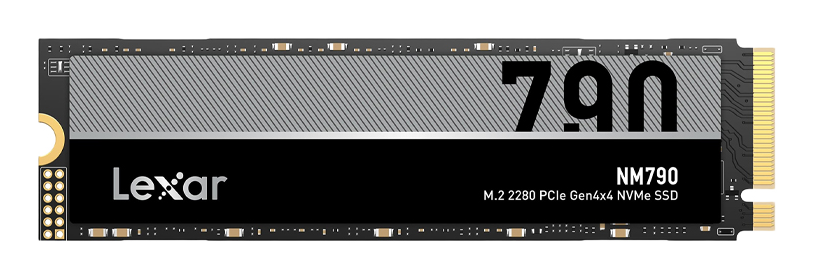
Lexar NM790 512GB
512GB · M.2 2280 · PCIe 4.0 x4
Specifications
No
DRAM cache
7200 MB/s
Sequential read
4400 MB/s
Sequential write
500 TBW
Endurance
Family guide
Lexar NM PCIe 3.0 and 4.0 SSDs| NM620 | NM800 PRO | NM710 | NM790 This model | |
|---|---|---|---|---|
| Released | 2021 | 2022 | 2023 | 2023 |
| Interface | PCIe 3.0 x4 | PCIe 4.0 x4 | Not available | PCIe 4.0 x4 |
| Read | 3500 MB/s | 7450 MB/s | Not available | 7200 MB/s |
| Write | 2400 MB/s | 3500 MB/s | Not available | 4400 MB/s |
| Endurance | 250 TBW | 500 TBW | Not available | 500 TBW |
| Summary | DRAM-less with TLC flash; it borrows a little system memory (HMB) instead. | The only member here with a DRAM cache, paired with TLC flash. | Shares the NM790's controller but uses older TLC flash, whose maker varies between batches. | DRAM-less with newer TLC flash than the NM710; its cache grows with capacity, so larger drives keep writes fast for longer. |
Capacity grid
| 256GB | 512GB | 1TB | 2TB | 4TB | 8TB | |
|---|---|---|---|---|---|---|
| NM620 | $99 | $109 | $189 | $445 | Not available | Not available |
| NM800 PRO | Not available | Out of stock | No listings | Out of stock | Not available | Not available |
| NM710 | Not available | Not available | Out of stock | Out of stock | Not available | Not available |
| NM790 | Not available | $178 This model | $289 | $468 | $785 | $1,999 |
Price history
$400$300$200$100$0
25 Apr09 Jun24 Jul07 Sept22 Oct
Price history excludes Amazon sources
Affiliate link disclosure: some product links on this page may be affiliate links. If you click on these links and make a purchase, we may earn a commission. This doesn't affect the price you pay or influence which listings are displayed.
Listings
Listings sorted by Price, ascending.
Lexar SSD 512GB 7200/4400 NM790 M.2 Lex NVME Amazon AU $178.00 Lexar LNM790 512GB M.2 2280 PCIe Gen4 NVMe SSD Centre Com $178.00 Lexar NM790 512GB PCIe 4.0 NVMe M.2 2280 SSD - LNM790X512G-RNNNG Mwave $178.00 Lexar NM790 PCIe Gen4 NVMe M.2 SSD - 512GB PLE $179.00 Lexar LNM790 512GB M.2 2280 PCIe Gen4 NVMe SSD Ebay AU $194.00 Lexar NM790 512GB M.2 2280 PCIe Gen4x4 NVMe SSD JW $199.00 Lexar NM790 512GB PCIe 4.0 M.2 2280 Internal SSD - 7200MB/s [AU] Ebay AU $218.46 Lexar LNM790X512G-RNNNG Internal SSD 512GB M.2 2280 PCIe Gen 4x4 NVMe SSD up Ebay AU $227.73 Lexar NM790 512GB PCIe 4.0 M.2 2280 Internal SSD - 7200MB/s Ebay AU $228.36 Lexar NM790 512GB PCIe 4.0 M.2 2280 Internal SSD - 7200MB/s Ebay AU $228.41 Lexar NM790 512GB PCIe 4.0 M.2 2280 Internal SSD - 7200MB/s Ebay AU $228.41 Lexar LNM790X512G-RNNNG Internal SSD 512GB M.2 2280 PCIe Gen 4x4 NVMe SSD up to Ebay AU $230.00 A - Lexar NM790 512GB PCIe 4.0 M.2 2280 Internal SSD - 7200MB/s Ebay AU $253.99 Lexar LNM790X512G-RNNNG Internal SSD 512GB M.2 2280 PCIe Gen 4x4 NVMe SSD up ... Ebay AU $299.00 Lexar NM790 512GB SSD 7200MB/s PCIe 4.0 NVMe M.2 2280 Internal Solid State Drive Out of stock Ebay AU — Lexar 512GB SSD NM790 7200MB/s PCIe 4.0 NVMe M.2 2280 Internal Solid State Drive Out of stock Ebay AU — Lexar NM790 512GB SSD PCIe 4.0 NVMe M.2 2280 7200MB/s Internal Solid State Drive Out of stock Ebay AU — Lexar NM790 512GB M.2 2280 NVMe PCIe 4.0 SSD Out of stock Scorptec — Lexar NM790 512GB SSD 7200MB/s PCIe G4 M.2 2280 NVMe Internal Solid State Drive Out of stock Ebay AU — Lexar NM790 512GB SSD, M.2 2280 PCIe Gen4x4 NVMe 1.4 Internal SSD, Up to 7200MB/s Read, Up to 4400MB/s Write, Internal Solid State Drive for PS5, PC, Laptop, Gamers, Professionals (LNM790X512G-RNNNG) Out of stock Amazon AU —