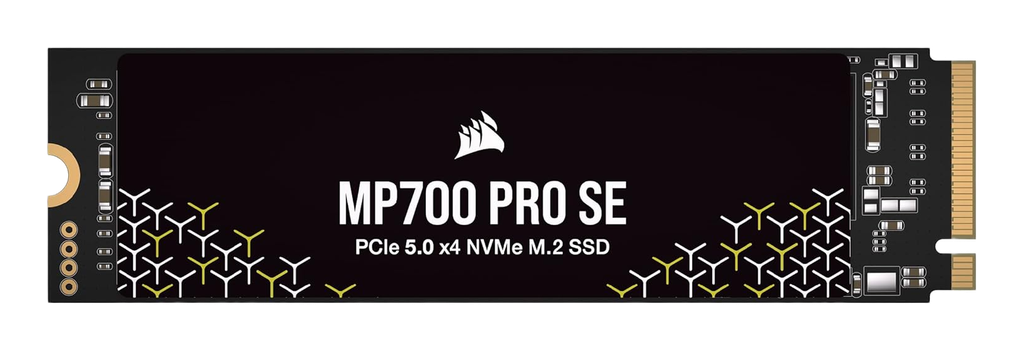
Corsair MP700 PRO SE 4TB
4TB · M.2 2280 · PCIe 5.0 x4
Specifications
Yes
DRAM cache
14000 MB/s
Sequential read
12000 MB/s
Sequential write
3000 TBW
Endurance
Family guide
Corsair MP700 SSDs| MP700 PRO | MP700 PRO SE This model | MP700 Elite | MP700 PRO XT | |
|---|---|---|---|---|
| Released | 2023 | 2024 | 2024 | 2025 |
| Interface | PCIe 5.0 x4 | PCIe 5.0 x4 | PCIe 5.0 x4 | Not available |
| Read | 12400 MB/s | 14000 MB/s | 9400 MB/s | Not available |
| Write | 11800 MB/s | 12000 MB/s | 8100 MB/s | Not available |
| Endurance | 3000 TBW | 3000 TBW | 2400 TBW | Not available |
| Summary | Has DRAM, but can run hot and may need strong cooling under sustained load. | Same controller and board as the MP700 PRO with faster flash. | DRAM-less and draws less power than the MP700 PRO, so it tends to run cooler. | Keeps a DRAM cache but draws far less power than the MP700 PRO and PRO SE, so it tends to run cooler. |
Capacity grid
| 1TB | 2TB | 4TB | |
|---|---|---|---|
| MP700 PRO | $443.90 | $576.94 | $1,386.31 |
| MP700 PRO SE | Not available | $766 | $1,587.39 This model |
| MP700 Elite | $359 | $646.31 | $1,209 |
| MP700 PRO XT | No listings | No listings | Not available |
How it compares
Explore current prices and specifications in the category table. View all SSDs →
Select a tick for details and a product link.
Read chart product details
Price history
$2,700$2,225$1,750$1,275$800
22 Apr05 Jun20 Jul02 Sept17 Oct
Price history excludes Amazon sources
Affiliate link disclosure: some product links on this page may be affiliate links. If you click on these links and make a purchase, we may earn a commission. This doesn't affect the price you pay or influence which listings are displayed.
Listings
Listings sorted by Price, ascending.
Corsair MP700 PRO SE with Air Cooler 4TB PCIe 5.0 x4 NVMe 2.0 M.2 SSD – M.2 2280 – Up to 14,000MB/sec Sequential Read – High-Density 3D TLC NAND – Black Amazon AU $1,587.39 Corsair MP700 PRO SE 4TB M.2 PCIe Gen5 x4 NVMe 2.0 SSD – M.2 2280 – Up to 14,000MB/sec Sequential Read – High-Density TLC NAND – Black Amazon AU $1,617.97 Corsair MP700 PRO SE Hydro X Series 4TB M.2 PCIe Gen5 x4 NVMe 2.0 SSD – M.2 2280 – Up to 14,000MB/sec Sequential Read – High-Density TLC NAND – Pre-Installed Water Block – Black Amazon AU $1,804.93