Nvidia GeForce RTX 5050
Released 2025/06
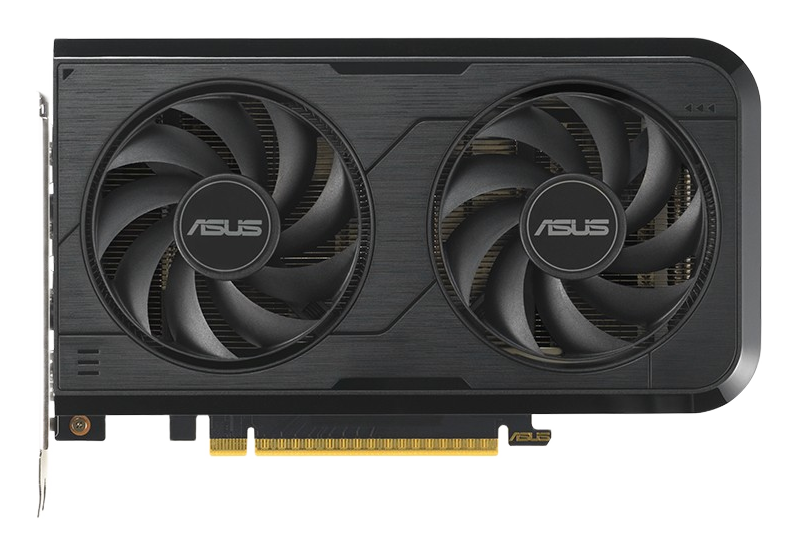
ASUS Dual GeForce RTX 5050 OC Edition 8GB
Specifications
8 GB
GDDR6 VRAM
320 GB/s
Bandwidth
2317 MHz
Boost clock
130 W
Board power
About this GPU
The RTX 5050 is Nvidia's entry-level Blackwell card, targeting 1080p gaming on a strict budget. The Blackwell silicon brings 4th-gen RT cores, 5th-gen Tensor cores, and DLSS 4 with Multi Frame Generation, but the hardware configuration keeps absolute performance similar to last-gen RTX 4060 territory.
At native 1080p across modern titles, the RTX 5050 averages around 66 fps. Specific games give a clear picture: Cyberpunk 2077 at the High preset averages 72 fps, Hogwarts Legacy and Star Wars Jedi: Survivor both land around 70 fps, and Marvel Rivals comes in at 50 fps at demanding settings. The AMD RX 9060 XT averages higher frame rates at 1080p in the same tests. DLSS 4 Multi Frame Generation can multiply displayed frame rates in supported titles, which is useful here because native performance is close to the edge in demanding games, though it requires game support and adds input latency. At 1440p the performance gap widens further.
The RTX 5050 is the only RTX 50-series desktop card using GDDR6 instead of GDDR7, reducing bandwidth to 320 GB/s versus 448 GB/s on the GeForce RTX 5060. It also runs on a PCIe 5.0 x8 lane rather than x16 - a constraint AMD's competing cards don't share - and both factors combine to make 1440p a real struggle.
The 130W TDP is the lowest in the RTX 50 desktop stack and requires only a single power connector. Whether that headroom translates to a quiet card depends on the AIB partner - premium cooler designs on some models run cleanly, but budget variants can hit 38 dBA and 1,900 RPM fan speeds under load, which is audible in most setups despite the modest power draw.
Pros and Cons
Pros:
- DLSS 4 with Multi Frame Generation available
- 130W TDP is the lowest in the RTX 50 desktop stack - works comfortably in compact builds with modest PSUs
- 320 GB/s memory bandwidth edges out the GeForce RTX 4060's 272 GB/s despite the same 128-bit bus, thanks to faster 20 Gbps GDDR6
- Mature Nvidia driver ecosystem with broad game compatibility and consistent feature support
Cons:
- Raw 1080p rasterization only matches or slightly trails the GeForce RTX 4060, while the RX 9060 XT is faster in the same tests
- The only RTX 50-series desktop card using GDDR6 over GDDR7 - 320 GB/s versus 448 GB/s on the GeForce RTX 5060 reduces 1440p headroom
- PCIe 5.0 x8 connection (versus x16 on competing AMD cards) adds another bandwidth constraint in texture-heavy workloads at higher resolutions
- Cooling quality varies by AIB partner - budget cooler designs on some models reach 38 dBA and 1,900 RPM fan speeds despite the 130W draw
Alternatives
- comparable gpu: Arc B580 - similar 1080p rasterization performance with 12GB of GDDR6, giving more texture headroom than the RTX 5050's 8GB
- budget pick: Arc B570 - a step below in raw performance but carries 10GB VRAM, which gives more breathing room than 8GB alternatives in newer texture-heavy releases
- upgrade pick: GeForce RTX 5060 - faster at 1080p, steps up to GDDR7 with 448 GB/s of bandwidth, and handles 1440p noticeably better
Price history
Price history excludes Amazon sources
Affiliate link disclosure: some product links on this page may be affiliate links. If you click on these links and make a purchase, we may earn a commission. This doesn't affect the price you pay or influence which listings are displayed.
Listings
Listings sorted by Price, ascending.